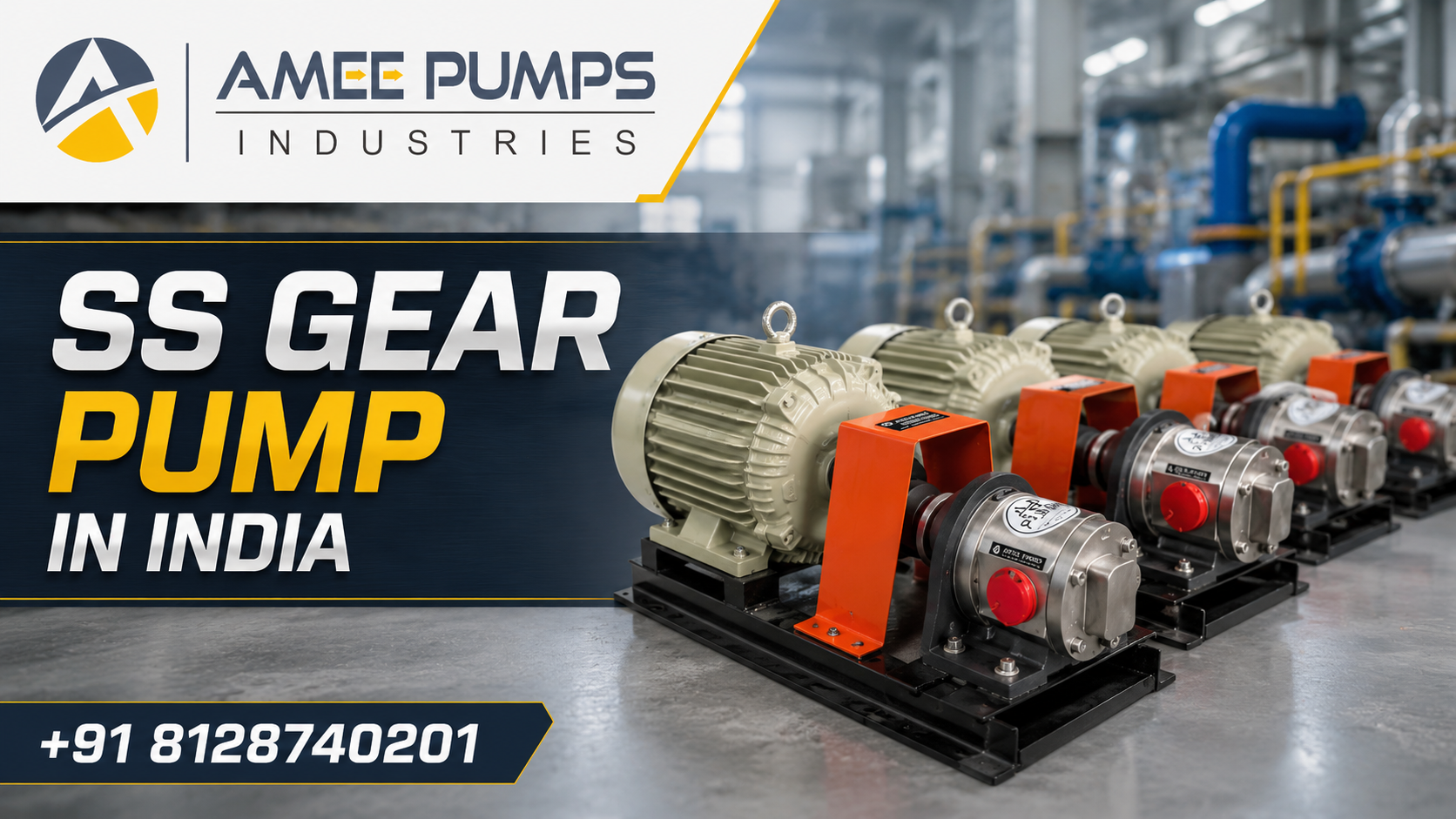
SS GEAR PUMP IN INDIA
Discover high-quality SS gear pumps in India. Amee Pumps Industries offers reliable, custom solutions for diverse industrial needs. Get expert advice.
What is an SS Gear Pump? An Overview
An SS gear pump is a type of positive displacement pump that uses the meshing of gears to pump fluid. It consists of two meshing gears, one driven and one idler, housed within a close-fitting casing. As the gears rotate, they create expanding cavities on the suction side, drawing fluid into the pump. The fluid is then trapped in the spaces between the gear teeth and the casing and is carried around to the discharge side. As the gears unmesh, the cavities decrease in volume, forcing the fluid out under pressure. The use of stainless steel for construction makes these pumps ideal for corrosive or hygienic applications.
Key Features and Technical Specifications
- Material of Construction: Typically manufactured from high-grade stainless steel (e.g., SS304, SS316, SS316L) for excellent corrosion resistance.
- Positive Displacement Mechanism: Ensures a constant flow rate irrespective of discharge pressure variations.
- Gear Design: Precision-machined gears (external or internal) for efficient fluid displacement and minimal slippage.
- Sealing Options: Available with various sealing arrangements like mechanical seals or gland packing to suit different fluid types and operating conditions.
- Pressure Capabilities: Capable of generating high pressures, suitable for demanding applications.
- Viscosity Handling: Efficiently pumps a wide range of fluid viscosities, from low to very high.
- Temperature Resistance: Can be designed to handle fluids at elevated temperatures.
- Hygiene Standards: Stainless steel construction is often suitable for food-grade and pharmaceutical applications.
Industrial Applications and Use Cases
- Chemical Processing: Transferring acids, alkalis, solvents, and other corrosive chemicals.
- Pharmaceuticals: Pumping viscous excipients, active pharmaceutical ingredients (APIs), and intermediates under hygienic conditions.
- Food and Beverage: Handling edible oils, syrups, chocolate, molasses, and dairy products where hygiene is paramount.
- Petrochemicals: Pumping lubricating oils, fuel oils, and various petroleum derivatives.
- Paints and Coatings: Transferring viscous paints, resins, and adhesives.
- Cosmetics: Pumping lotions, creams, and other viscous cosmetic formulations.
- Polymer and Resin Production: Metering and transferring viscous polymers and resins.
- Wastewater Treatment: Pumping sludge and viscous effluent.
How to Choose the Right SS Gear Pump
Selecting the appropriate SS gear pump involves careful consideration of several factors to ensure optimal performance and longevity.
- Fluid Properties: Determine the exact chemical composition, viscosity (at operating temperature), specific gravity, and temperature of the fluid to be pumped. This dictates the material of construction and sealing requirements.
- Flow Rate and Pressure: Define the required flow rate (e.g., liters per minute or gallons per minute) and the maximum discharge pressure needed for your process.
- Material Compatibility: Ensure the stainless steel grade and any other wetted parts are fully compatible with the pumped fluid to prevent corrosion or contamination.
- Operating Environment: Consider ambient temperature, potential for dust or moisture, and any hazardous area classifications.
- Drive Mechanism: Select an appropriate motor and drive system (e.g., direct coupling, belt drive) that meets power and speed requirements.
- Sealing Requirements: Choose between mechanical seals or gland packing based on fluid characteristics, pressure, and safety considerations.
- Certifications and Standards: Verify if the pump meets relevant industry standards (e.g., ATEX for hazardous areas, FDA for food contact).
- Supplier Reputation and Support: Partner with a reputable manufacturer or supplier known for quality, technical expertise, and after-sales service.
Quality Standards and Compliance
When procuring SS gear pumps, especially for critical industrial applications in India, adhering to quality standards and compliance is non-negotiable. Manufacturers should ideally follow international standards such as ISO 9001 for quality management systems. For specific applications, compliance with standards like ASME for pressure vessel design, or specific material certifications for stainless steel grades, is crucial. Pumps intended for food or pharmaceutical use must meet stringent hygiene standards, often requiring certifications like FDA compliance or adherence to Good Manufacturing Practices (GMP). Buyers should always verify the material test certificates (MTCs) for the stainless steel used and ensure the pump design and manufacturing processes align with industry best practices to guarantee reliability and safety.
Why Amee Pumps Industries' Experience and Capability Matters
At Amee Pumps Industries, our two decades of experience, guided by Mr. Amit Panchal's expertise, have shaped our approach to designing and manufacturing SS gear pumps. We leverage a technology-driven manufacturing process that allows for precision engineering and cost-effectiveness, particularly in complex custom designs. Our team possesses deep technical knowledge, enabling us to understand the nuances of various industrial fluid transfer challenges.
We maintain rigorous quality control throughout our manufacturing cycle, ensuring each pump meets stringent performance and durability standards. Our capability extends to offering customized solutions tailored to specific client requirements, a critical factor for specialized applications. We are committed to reliable delivery and providing comprehensive after-sales support, ensuring our clients receive not just a pump, but a complete, dependable fluid transfer solution.
Installation, Maintenance, and Care Tips
Proper installation and regular maintenance are key to maximizing the lifespan and performance of your SS gear pump.
Installation
Ensure the pump is installed on a solid, level foundation to minimize vibration.
Align the pump and motor shafts accurately if using a coupling.
Connect suction and discharge piping securely, ensuring no strain on the pump casing.
Prime the pump before starting operation, especially for the first run.
Ensure proper rotation direction as indicated by the manufacturer.
Maintenance
Regularly check for leaks around seals and connections.
Monitor bearing temperatures and listen for unusual noises, which can indicate wear.
Inspect gears for signs of wear or damage during scheduled overhauls.
Lubricate bearings as per manufacturer recommendations.
Check and clean strainers on the suction line to prevent blockages.
Follow the manufacturer's recommended service intervals for seal replacement or gland repacking.
Care:
Avoid running the pump dry, as this can damage seals and gears.
Do not operate the pump against a closed discharge valve for extended periods.
Protect the pump from extreme environmental conditions if not designed for them.
Use only recommended lubricants and spare parts.
Frequently Asked Questions
Stainless steel offers excellent resistance to corrosion and chemical attack, making it ideal for handling aggressive or sensitive fluids. Its durability and hygienic properties also make it suitable for food-grade and pharmaceutical applications, ensuring product purity and pump longevity in challenging environments.
Yes, SS gear pumps are inherently designed to handle high-viscosity fluids efficiently. Their positive displacement mechanism ensures a consistent flow rate by trapping and moving discrete volumes of fluid, minimizing slippage even with thick liquids, unlike centrifugal pumps.
Common failure points include wear on the gears and casing due to abrasive fluids or inadequate lubrication, seal leakage caused by chemical attack or wear, bearing failure from excessive load or poor lubrication, and potential damage from running dry or cavitation.
Temperature primarily affects fluid viscosity. As temperature increases, viscosity generally decreases, which can lead to increased slippage and a slight reduction in flow rate for a given speed. Conversely, lower temperatures increase viscosity, potentially requiring more power to drive the pump.
Mechanical seals typically require minimal routine maintenance but should be monitored for leaks. They are wear components and will eventually need replacement. It's crucial to ensure the pumped fluid is compatible with seal materials and that the pump is not operated dry, as this can quickly damage the seal faces.
Yes, SS gear pumps can be designed for hazardous environments. This often involves using explosion-proof motors, ensuring proper grounding to prevent static discharge, and selecting materials and sealing arrangements that comply with relevant safety standards like ATEX or IECEx.
Conclusion
For industries in India requiring robust, reliable, and corrosion-resistant fluid transfer solutions, SS gear pumps represent a superior choice. Their ability to handle a wide range of viscosities and challenging media, combined with the inherent benefits of stainless steel, makes them indispensable in sectors from chemical processing to food manufacturing. When selecting an SS gear pump, carefully consider your specific fluid properties, operational demands, and the manufacturer's expertise. Partnering with an experienced supplier like Amee Pumps Industries ensures you receive a high-quality, custom-engineered solution backed by technical proficiency and a commitment to performance.
Get In Touch
Amee Pumps Industries
