Industrial Mud Pump Manufacturer in Ahmedabad
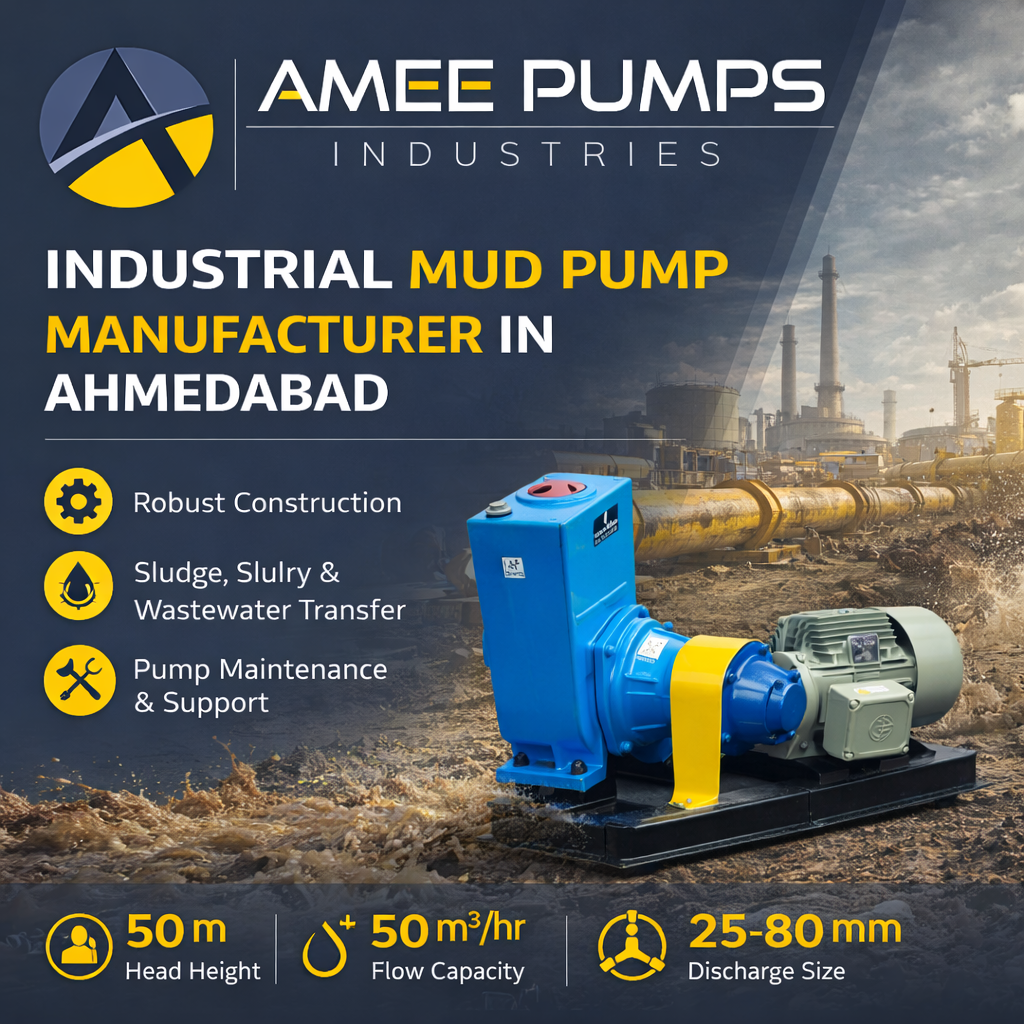
Industrial Mud Pump
Manufacturer in Ahmedabad
Industrial operations often require reliable systems to transfer sludge, slurry, sewage, and high-solid liquids between processing units, storage tanks, and treatment systems.
Specialized Pumping Equipment for Viscous & Debris-Laden Fluids
An Industrial Mud Pump Manufacturer in Ahmedabad supplies specialized pumping equipment designed to handle viscous and debris-laden fluids that conventional pumps cannot manage efficiently. These pumps play an important role in sectors such as wastewater treatment, construction, mining, chemical processing, and infrastructure maintenance.
Ahmedabad is one of Gujarat's major industrial hubs, with large manufacturing clusters located in areas such as Vatva, Naroda, Odhav, Kathwada, and Changodar. Industries operating in these regions regularly manage wastewater, sludge, mud, and industrial effluents during their production and processing activities. In such environments, a robust mud pumping system ensures smooth material transfer while helping prevent pipeline blockages and operational downtime.
Self priming mud pumps are widely used in industrial facilities because they simplify pump operation and maintenance. Their ability to automatically prime and remove trapped air during operation allows industries to handle difficult fluids without complex priming procedures, making them a practical solution for heavy-duty liquid handling systems.
Understanding Industrial Mud Pump Systems
Industrial mud pumps are designed specifically for pumping thick liquids that contain solid particles such as sludge, mud, sand, and organic waste. Unlike standard water pumps, these machines are engineered with durable internal components capable of withstanding abrasive materials while minimizing the risk of clogging during operation.
A self priming mud pump automatically evacuates air from the suction line during startup. This feature allows the pump to begin moving fluid without requiring manual priming. The pump chamber creates a vacuum that draws liquid into the system while simultaneously releasing trapped air, enabling stable pumping performance even when the suction line initially contains air.
Because of their specialized construction, these pumps are suitable for applications where continuous fluid transfer is required and fluid characteristics may vary in viscosity or solid content.
How Self Priming Mud Pumps Work
A self priming mud pump operates using an internal pumping chamber that mixes air and liquid during the priming process. As the impeller rotates, it creates a vacuum that pulls fluid into the suction line while expelling air through the discharge system.
Once the pump becomes fully primed, the remaining air is removed from the system and the pump continues to move liquid efficiently. This process enables the pump to maintain stable performance even in systems where fluid levels fluctuate or pipelines occasionally contain air pockets.
The self priming capability significantly reduces the need for manual intervention and simplifies installation in industrial environments where frequent priming could otherwise interrupt operations.
Key Technical Characteristics of Industrial Mud Pumps
Industrial mud pumps used in manufacturing and wastewater systems are designed to perform under demanding operating conditions. These pumps are typically built with corrosion-resistant materials and sealing systems that support reliable performance across different types of industrial fluids.
Typical technical characteristics include:
- Head capacity up to 50 meters
- Operating pressure around 5 kg/cm²
- Flow capacity up to 50 m³ per hour
- Discharge size ranging from 25 mm to 80 mm
- Pump body materials including CI, SS304, SS316, SS316L, and mild steel
- Sealing systems available with gland packing or mechanical sealing
These specifications enable the pump to manage a wide range of industrial fluids while maintaining durability in continuous operating environments.
Applications of Industrial Mud Pumps
Industrial mud pumps are used across numerous sectors where sludge, slurry, or wastewater must be transported safely and efficiently. Their ability to handle fluids containing suspended solids makes them an essential component in many industrial processes.
Common applications include:
- Wastewater treatment plants handling sludge and sewage transfer
- Construction sites removing mud and slurry from excavation areas
- Chemical processing facilities managing industrial effluents
- Mining operations transporting slurry mixtures
- Paper and pulp industries transferring waste liquids
- Textile processing units handling dye effluents
- Municipal sewage systems moving wastewater between treatment stages
These pumps support reliable fluid movement in environments where clogging or pump failure could interrupt critical operations.
Industrial Demand for Mud Pumps in Ahmedabad
Ahmedabad's industrial ecosystem includes a wide range of manufacturing sectors that generate wastewater and sludge during production processes. Industrial estates across the city frequently require efficient pumping systems to manage these fluids while maintaining environmental compliance and operational efficiency.
Industries such as chemicals, pharmaceuticals, textiles, engineering, and food processing often install mud pumps to transfer effluent between storage tanks, filtration systems, and treatment plants. In addition, infrastructure projects, municipal drainage systems, and construction sites rely on mud pumps to manage sludge and muddy water during excavation and site preparation.
Because of these operational needs, reliable mud pump systems have become an important part of industrial infrastructure across the region.
Benefits of Using Self Priming Mud Pumps
Self priming mud pumps provide several operational advantages that make them suitable for industrial fluid transfer systems. Their design simplifies pump operation while supporting consistent performance in demanding environments.
Key advantages include:
- Automatic self-priming capability that eliminates manual priming procedures
- Ability to handle fluids containing suspended solids and debris
- Reduced risk of clogging due to specialized internal design
- Consistent pumping performance across varying fluid conditions
- Suitable for continuous industrial operations
- Simplified installation in wastewater and sludge handling systems
These features allow industries to maintain reliable pumping systems while minimizing maintenance interruptions.
Industrial Pump Material Selection for Corrosive Fluids
Material selection is an important consideration in the design of industrial mud pumps because different fluids may contain chemicals, corrosive substances, or abrasive particles. Pump manufacturers typically provide multiple material options to ensure compatibility with various industrial environments.
Cast iron is commonly used for general industrial applications due to its strength and durability. Stainless steel variants such as SS304 and SS316 provide enhanced corrosion resistance, making them suitable for chemical processing and wastewater treatment environments. SS316L offers additional resistance to corrosive substances and is often selected for applications involving aggressive chemicals.
Selecting the appropriate pump material helps extend service life and maintain stable pump performance during long operating cycles.
Maintenance Considerations for Industrial Mud Pumps
Proper maintenance plays an important role in ensuring long-term reliability in industrial pumping systems. Since mud pumps often handle abrasive fluids and suspended solids, routine inspection and maintenance help prevent performance issues.
Industrial facilities generally follow several maintenance practices to support efficient pump operation:
- Regular inspection of sealing components and gland packing
- Monitoring pump vibration and operating temperature
- Periodic cleaning of suction lines and strainers
- Checking impeller wear caused by abrasive particles
- Ensuring proper alignment and lubrication of rotating components
Consistent maintenance helps extend pump lifespan while reducing the risk of unexpected downtime in industrial processes.
Choosing the Right Industrial Mud Pump
Selecting the appropriate mud pump requires evaluating several technical and operational factors related to the specific application. Industrial facilities typically assess flow requirements, fluid characteristics, and installation conditions when choosing a pump system.
Important selection factors include pump capacity, discharge size, suction lift requirements, fluid viscosity, solid particle size, and operating pressure. Environmental conditions such as temperature, chemical exposure, and installation location may also influence pump configuration and material selection.
Understanding these parameters helps industries implement pumping systems that operate reliably while meeting process efficiency and safety requirements.
Frequently Asked Questions
A self priming mud pump is an industrial pump designed to automatically remove air from the suction line during startup. This allows the pump to begin transferring sludge, slurry, or sewage without manual priming, making it suitable for wastewater and industrial fluid handling systems.
Industrial mud pumps are widely used in wastewater treatment plants, construction projects, mining operations, municipal sewage systems, chemical processing facilities, and industries where sludge or slurry must be transported between different processing stages.
Mud pumps are specifically designed to handle liquids containing suspended solids, debris, and sludge. Their internal construction is engineered to reduce clogging and withstand abrasive materials, unlike standard pumps that are primarily intended for clean water applications.
Self priming capability enables the pump to automatically remove trapped air from the suction line during startup. This eliminates the need for manual priming and helps ensure faster, more reliable pump operation in industrial systems.
Pump capacity is selected based on the required flow rate, suction lift, discharge pressure, and fluid characteristics. Engineers evaluate these parameters to ensure the pump can effectively handle the specific sludge or slurry conditions within the system.
Industrial mud pumps are typically manufactured using materials such as cast iron, stainless steel 304, stainless steel 316, stainless steel 316L, and mild steel. These materials provide the strength, corrosion resistance, and durability needed for demanding industrial environments.
Get in Touch
Our Blogs
- Acids Transfer PVDF Chemical Pump
- Air Cooled Pump Set
- Thermic Fluid Hot Oil Air Cooled Pump
- Air Operated Double Diaphragm SS 316 Pump
- AODD Pump PVDF MOC
- Centrifugal End Suction Pump
- High Pressure Centrifugal Pump
- Vertical Centrifugal Pump
- Hygienic Centrifugal Pump
- Petroleum Industry Centrifugal Process Pump
- Self Priming Boiler Feed Pump
- Bare Shaft PP Pump
- Self Priming Monoblock Mud Pump
- Hot Oil Centrifugal Pump
- Horizontal Centrifugal Back Pull Out Bare Shaft Coupled Pump
- Teflon Line Centrifugal Process Pump
- Corrosion Resistant Pump
- Semi Open Impeller Centrifugal Pump
- Corrosion Resistant Polypropylene Pump
- Boiler Feed Pump
- 20 LPM Oil Gear Pump
- PVDF Loading Unloading Centrifugal Pump
- Vertical Extended Shaft Slurry Pump
- Pneumatic Air Operated Double Diaphragm Pump
- CF Series Stainless Steel Centrifugal Pump
- Oil Transfer Rotary Gear Pump
- High Temperature Pump
- Horizontal Centrifugal End Suction Pump
- Sewage Plants Self Priming Mud Pump
- Caustic Vertical Pump
- Polypropylene Gland Less Pump
- 300 LPM Acid Pump
- Single Stage Centrifugal Back Pull Out Pump
- Water Treatment Centrifugal Back Pull Out Pump
- Vertical Extended Shaft Sump Pump
- Horizontal Slurry Pump
- Mechanical Diaphragm Dosing Pump
- 2 HP Centrifugal Pump
- Vertical Long Shaft Sump Pump
- Stainless Steel Pump
- Centrifugal Circulation Process Pump
- Thermic Fluid Hot Oil Pump
- Self Priming Non Clog SS 316 Mud Pump
- Vertical Long Shaft Submerged Centrifugal Pump
- High Pressure Multi Stage Boiler Feed Pump
- Vertical Sump Pump
- Side Suction Pump
- Polypropylene Descaling Pump
- Non Clog Impeller Pump
- High Discharge Pump
- Filter Press Feeding Pump
- Polypropylene Chemical Process Pump
- Magnetic Drive Polypropylene Pump
- Water Circulation Pump
- Non Metallic Pump
- Side Suction Bare Shaft Pump
- SS 304 Centrifugal Fabricated Pump
- SS316 Rotary Gear Pump
- Centrifugal Flameproof Pump
- Corrosion Resistant PVDF Chemical Pump
- Centrifugal Pump Closed Impeller
- Stainless Steel Centrifugal Pump
- Corrosion Resistant PP Pump
- Heavy Duty Rotary Gear Pump
- External Gear Pump
- SS 316 AODD Pump
- Self Priming Non Clog Mud Pump
- Hot Oil Circulation Pump
- Internal Gear Pump
- Pneumatic Double Diaphragm Pump
- Thermic Fluid Boiler Feed Pump
- Magnetic Chemical Pump
- ETP Slurry Pump
- Filter Press Feed Pump
- Water Transfer Pump
- PVDF Lined Chemical Process Pump
- Industrial Chemical Process Pump
- SS Chemical Transfer Pump
- Vertical Single Stage Centrifugal Pump
- Hot Oil Circulation Pump in India
- Centrifugal Pump Manufacturers & Suppliers in India
- Chemical Process Pump Manufacturer in India
- Horizontal Single Stage Centrifugal Pump
- Self Priming Stainless Steel Pump
- Rotary Gear SS 316 Pump
- PVDF Chemical Pump in India
- PP AODD Pump
- PP Chemical Process Pump
- Vertical Long Shaft Sump Pump
- Air Cooled Thermic Fluid Hot Oil Pump
- Centrifugal Chemical Process Pump
- Air Operated Diaphragm Pneumatic Pump
- Industrial AODD Pump
- SS Air Operated Diaphragm Pump
- Air Cooled Pump Manufacturer & Supplier in India
- AIR COOLED HOT OIL PUMP
- PP Air Operated Double Diaphragm Pumps
- Vertical Inline Single Stage Centrifugal Pump
- Magnetic Drive Acid Handling Pump
- PVDF LINED CENTRIFUGAL PUMP
- Horizontal Single Stage Centrifugal Pumps
- SS 316 Pumps Centrifugal Chemical Transfer
- Pvdf Chemical Process Pump
- Self Priming Stainless Steel Pump in india
- SS TWIN LOBE PUMP
- SS ROTARY GEAR PUMP
- HOT OIL AIRCOOLED PUMP
- SS CENTRIFUGAL PUMPS IN INDIA
- SS GEAR PUMP IN INDIA
- PVDF MAGNATIC DRIVE PUMP
- Filter Press Side Suction Pump
- CHEMICAL PROCESS PUMP
- CENTRIFUGAL COUPLED PUMP
- THERMIC FLUIED AIR COOLED PUMP
- Lobe Pump in India
- SS Self Priming Mud Pump in Gujarat
- Solvent Transfer Pump in Gujarat
- PVDF Centrifugal Pump in Ahmedabad
- Rotary Lobe Pump in Ahmedabad
- End Suction Pumps Gujarat
- SS Centrifugal Pump in Gujarat
- Solvent Transfer Pump in Ahmedabad
- Vertical Seal Less Gland Less PP Pump in Ahmedabad
- VERTICAL SEAL LESS GLAND LESS PP PUMP
- PP SELF PRIMING PUMP
- SOLVENT TRANSFER PUMP
- SS CENTRIFUGAL PUMP
- ROTARY GEAR PUMP
- CENTRIFUGAL PP PUMP
- CHEMICAL PROCESS CENTRIFUGAL PUMP
- ROTARY LOBE PUMP
- Filter Press Side Suction Pump in Gujarat
- Air Cooled Thermic Fluid Pump in India
- SS Centrifugal Monoblock Pump in Ahmedabad
- MAGNATIC DRIVE CENTRIFUGAL PUMP
- ACID APPLICATION PUMP
- AIR OPERATED DOUBLE DIAPHRAGAM PUMP
- LOBE PUMP
- HORIZONTAL CENTRIFUGAL PUMP
- SS GEAR PUMP
- FIRE FIGHITING PUMPS
- FILLTER PRESS PUMP
- BACK PULL OUT SS CENTRIFUGAL PUMP
- PP SELF PRIMING PUMP
- Horizontal Back Pull Out End Suction Pumps in India
- Hot Oil Pump in Gujarat
- PVDF Centrifugal Pump in Gujarat
- Centrifugal Pump
- Thermic Fluid Air Cool Pump
- PP Pump
- PVDF Centrifugal Pump Manufacturers in Gujarat
- End Suction Pumps in Ahmedabad
- Bentonite Pumps in Gujarat
- SS SELF PRIMING MUD PUMP
- PP MONOBLOCK PUMP
- SS CENTRIFUGAL MONOBLOCK PUMP
- LOBE PUMP
- FILLTER PRESS SIDE SUCTION PUMP
- HOT OIL PUMP
- AIR COOLED THERMIC FLUID PUMP
- PVDF CENTRIFUGAL PUMP MANUFACTURERS IN AHMEMDABAD
- Magnetic Drive PP Pump
- Horizontal Back Pull Out End Suction Pumps in Gujarat
- Bentonite Pumps in Gujarat
- AIR OPERATED DIAPHRAGAM PUMP
- MAGNATIC DRIVE PP PUMP
- Rotary Gear Pumps
- PVDF CENTRIFUGAL PUMP
- End Suction Pumps in Gujarat
- Centrifugal Process Pump in Ahmedabad
- Horizontal Back Pull Out End Suction Pumps Manufacturer in Ahmedabad
- Bentonite Pumps Manufacturer in Ahmedabad
- Chemical Process Centrifugal Pump Supplier in Ahmedabad
- End Suction Pumps
- Centrifugal Process Pump
- Horizontal Back Pull Out End Suction Pumps
- Chemical Process Centrifugal Pump
- BENTONITE PUMPS
- Pp Centrifugal Acidic Liquid Transfer Pump
- Centrifugal Process Pump For Evaporators
- Polypropylene Aodd Pump
- PP Centrifugal Monoblock Pump
- Self Priming Mud Pump in Ahmedabad
- Rotary Gear Pump Supplier in Ahmedabad
- AODD Pump in Ahmedabad
- PP Monoblock Pump in Ahmedabad
- Centrifugal Couple Drive Chemical Process Pump
- SS 316 Pumps Centrifugal Chemical Transfer in Ahmedabad
- Eva Operation Pump
- Air Operated Double Diaphragm Pump Manufacturer in Ahmedabad
- Industrial Mud Pump Manufacturer in Ahmedabad
- AODD Pump Supplier in Gujarat
- Self Priming Mud Pump in Gujarat
- PP Monoblock Pump Supplier in Ahmedabad
- PP Centrifugal Pump Manufacturer in India
- Chemical Transfer Pump Supplier in Gujarat
- End Suction Pump Manufacturer in Ahmedabad
- Centrifugal Back Pull Out Pump Manufacturer in India
- SS Centrifugal Pump Manufacturing Company in Gujarat
- SS Gear Pump Supplier in Ahmedabad
- Rotary Gear Pump Manufacturer in India
- Flange Mounted Rotary Gear Pump Manufacturer in India
- Horizontal Centrifugal Pump Supplier in Gujarat
- Acid Transfer Pump Manufacturer in India
- Multistage Boiler Feed Pump Manufacturing in Gujarat
- Polypropylene Pump in India
- Chemical Process Pump in Ahmedabad
- High Pressure Multistage Boiler Feed Pump in Gujarat
- Vertical Inline Centrifugal Pump in Ahmedabad
- Magnetic Drive Pumps in Ahmedabad
- Lobe Pump in Ahmedabad
- PP Monoblock Pump Supplier in India
- PP Centrifugal Pump Manufacturer in Ahmedabad
- Chemical Transfer Pump Supplier in India
- End Suction Pump Manufacturer in Gujarat
- Centrifugal Back Pull Out Pump in Gujarat
- SS Centrifugal Pump Manufacturer in India
- SS Gear Pump Manufacturer in Gujarat
- Hot Oil Pump in ahemdabad
- Air Cooled Thermic Fluid Pump Manufacturer in Gujarat
- Air Cooled Pump Manufacturer in Gujarat
- Rotary Gear Pump Manufacturer in Ahmedabad
- Bentonite Pump Manufacturer in India
- Centrifugal Back Pull Out Pump Manufacturer in Ahmedabad
