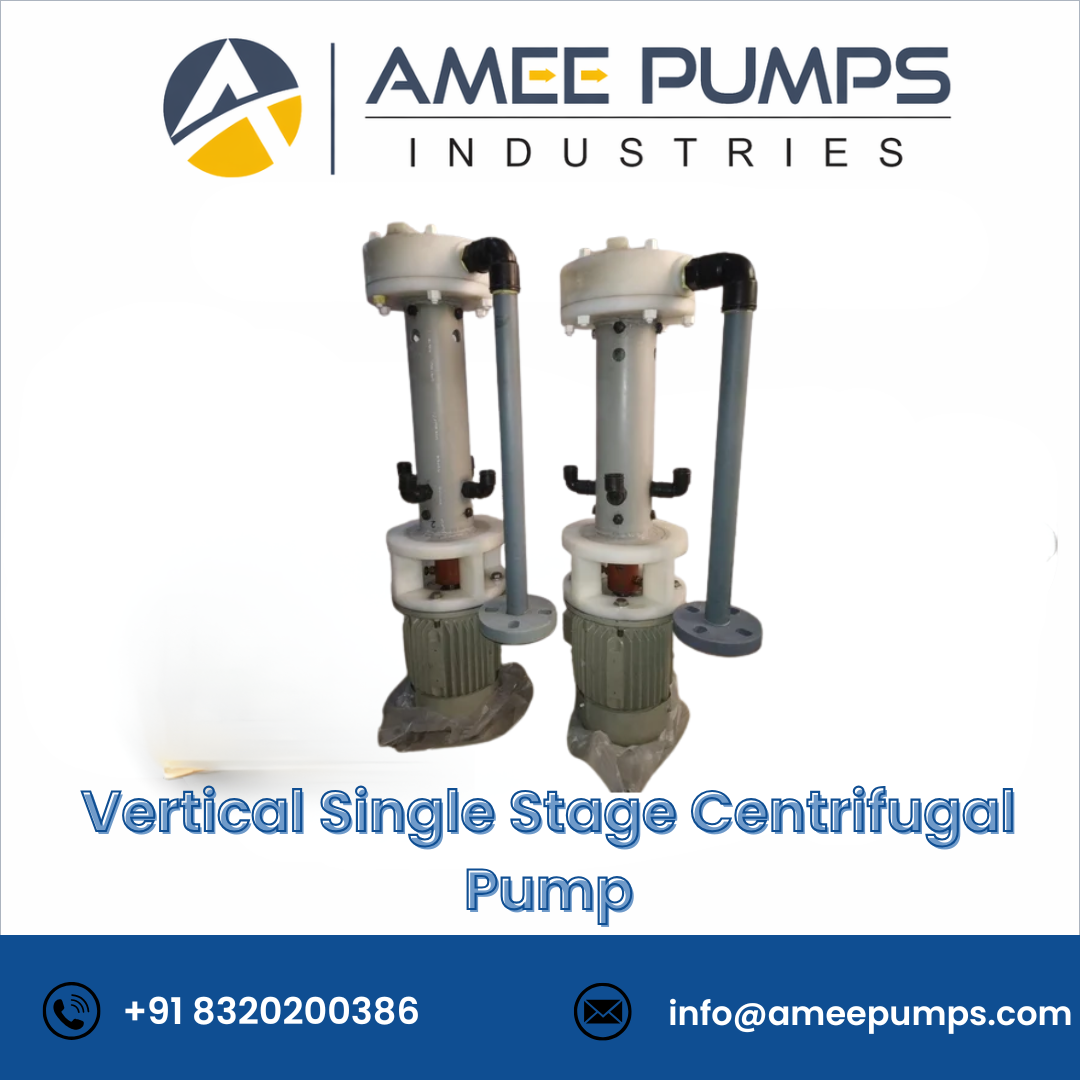
Vertical Single Stage Centrifugal Pump
Expertly designed Vertical Single Stage Centrifugal Pumps for industrial applications in Ahmedabad. Reliable, efficient, and cost-effective solutions from Amee
What is a Vertical Single Stage Centrifugal Pump? — Overview
A vertical single stage centrifugal pump is a type of dynamic pump that utilizes a rotating impeller to impart kinetic energy to a fluid, which is then converted into pressure energy. Its defining characteristic is its vertical shaft orientation, allowing the motor to be mounted above the pump casing. "Single stage" signifies that the pump uses only one impeller to achieve the required head and flow rate. This design makes them compact, often requiring less floor space than their horizontal counterparts, and they are commonly used for moderate head and flow applications.
Key Features and Technical Specifications
- Vertical Shaft Design: Minimizes footprint and simplifies installation, especially in confined spaces.
- Single Impeller Configuration: Offers straightforward operation and maintenance for specific flow and head requirements.
- Robust Casing Construction: Typically made from cast iron, stainless steel, or other corrosion-resistant alloys to handle various fluid types.
- Motor Mounting: Motor is mounted directly above the pump, often with a rigid coupling, ensuring efficient power transfer.
- Sealing Arrangements: Available with mechanical seals or gland packing to prevent leakage and ensure operational safety.
- Discharge Orientation: Can be configured for top or side discharge, offering flexibility in piping layouts.
- Material Options: Impeller and casing materials can be selected based on fluid properties, such as corrosivity and temperature.
Industrial Applications and Use Cases
- Water Supply and Distribution: Pumping municipal water, treated wastewater, and industrial process water.
- Chemical Processing: Transferring acids, alkalis, solvents, and other chemicals in various concentrations.
- Pharmaceutical Manufacturing: Handling purified water, solvents, and intermediates in a sterile environment.
- Food and Beverage Industry: Pumping liquids like juices, oils, syrups, and dairy products.
- Cooling Systems: Circulating cooling water for machinery, HVAC systems, and industrial processes.
- Irrigation: Supplying water for agricultural purposes in large-scale farming operations.
- General Industrial Transfer: Moving a wide range of liquids in manufacturing and processing plants.
How to Choose the Right Vertical Single Stage Centrifugal Pump
Selecting the appropriate vertical single stage centrifugal pump requires careful consideration of your specific operational needs. Here’s a checklist to guide your decision:
- Fluid Characteristics: Identify the type of fluid, its viscosity, temperature, corrosivity, and presence of solids. This dictates material selection and seal type.
- Flow Rate and Head Requirements: Determine the precise volume of fluid to be moved per unit of time and the total pressure the pump must overcome.
- Power Source and Voltage: Ensure compatibility with available electrical supply and motor specifications.
- Installation Space: Assess the available footprint and vertical clearance for the pump and motor assembly.
- Environmental Conditions: Consider ambient temperature, humidity, and potential exposure to hazardous substances.
- Efficiency and Energy Consumption: Look for pumps designed for optimal energy efficiency to reduce operational costs.
- Reliability and Durability: Prioritize robust construction and reputable brands known for longevity.
- After-Sales Support and Service: Evaluate the availability of spare parts, maintenance services, and technical assistance.
Quality Standards and Compliance
For industrial applications, especially in sectors like pharmaceuticals, chemicals, and food processing, adherence to stringent quality standards and compliance with relevant regulations is non-negotiable. Buyers should verify that the pumps they consider meet national and international standards such as those set by the Bureau of Indian Standards (BIS), ISO certifications (e.g., ISO 9001 for quality management), and specific industry guidelines. Ensuring the pump materials are food-grade or chemically resistant as required, and that the manufacturing process adheres to strict quality control measures, guarantees safety, performance, and longevity.
Why Amee Pumps Industries' Experience and Capability Matters
At Amee Pumps Industries, our two decades of experience, led by Mr. Amit Panchal, have been dedicated to mastering the design and manufacturing of efficient pump solutions. We employ a technology-driven approach that allows for precision engineering and cost-effective production, a critical advantage in today's competitive industrial environment. Our manufacturing processes are honed for speed and accuracy, enabling us to deliver reliable pumps that meet exact specifications.
We understand that each industrial application has unique demands. Our technical team possesses the expertise to analyze these requirements and recommend or customize vertical single stage centrifugal pumps that offer optimal performance and longevity. Our commitment extends beyond manufacturing; we focus on ensuring consistent quality control throughout our production cycle and providing dependable after-sales support. This holistic approach ensures that our clients in Ahmedabad and beyond receive not just a pump, but a complete, reliable fluid handling solution.
Installation, Maintenance, and Care Tips
Proper installation and regular maintenance are key to maximizing the lifespan and performance of your vertical single stage centrifugal pump.
- Installation: Ensure the pump is installed on a solid, level foundation to prevent vibration. Align the motor and pump shaft precisely. Connect piping carefully, avoiding stress on the pump casing. Verify that the motor rotation direction matches the pump's requirement before initial startup.
- Priming: Before starting, ensure the pump casing and suction line are completely filled with the liquid to be pumped. Air trapped in the system can prevent the pump from operating correctly.
- Operation: Avoid running the pump dry, as this can damage seals and impellers. Monitor operating parameters like pressure, temperature, and vibration regularly.
- Maintenance: Periodically inspect seals for leaks. Check bearings for noise or excessive heat. Clean strainers and filters to maintain optimal flow. Follow the manufacturer's recommended lubrication schedule for the motor and any pump bearings.
- Troubleshooting: Address any unusual noises, vibrations, or reduced performance promptly. Consult the operation manual or contact a qualified service technician.
Frequently Asked Questions
The primary advantage is its compact, vertical design, which requires significantly less floor space compared to horizontal pumps, making it ideal for installations with limited space. This design also simplifies installation and maintenance in many scenarios.
Correct sizing involves accurately calculating your required flow rate (e.g., liters per minute or gallons per hour) and the total dynamic head (the total pressure the pump needs to overcome). These parameters, along with fluid properties, are crucial for selecting an appropriately sized pump.
Vertical single stage centrifugal pumps can handle a wide range of clean or slightly contaminated liquids, including water, chemicals, oils, and food products, provided the pump materials and seals are compatible with the fluid's properties like corrosivity and temperature.
With proper installation, operation, and regular maintenance, a well-selected vertical single stage centrifugal pump can last anywhere from 10 to 20 years or even longer. Factors like fluid abrasiveness, operating conditions, and maintenance frequency significantly influence lifespan.
While single stage pumps are designed for moderate head applications, their suitability for high-pressure scenarios depends on the specific impeller design and motor power. For very high pressures, multi-stage pumps are typically recommended.
Routine maintenance includes checking for leaks at the seal, monitoring bearing condition, ensuring proper lubrication, and cleaning any intake strainers. Periodic inspections of the impeller and casing for wear or damage are also advisable.
Conclusion
For industries in Ahmedabad seeking efficient, reliable, and space-saving fluid transfer solutions, the vertical single stage centrifugal pump offers a compelling choice. Its design inherently addresses many common industrial challenges, from limited installation space to the need for consistent performance. When selecting a pump, prioritizing factors like fluid compatibility, precise flow and head requirements, and adherence to quality standards is essential. Partnering with an experienced manufacturer like Amee Pumps Industries ensures you receive not only a high-quality product but also the technical expertise and support necessary to integrate it seamlessly into your operations, guaranteeing sustained efficiency and reliability.
---
Get In Touch
Amee Pumps Industries
