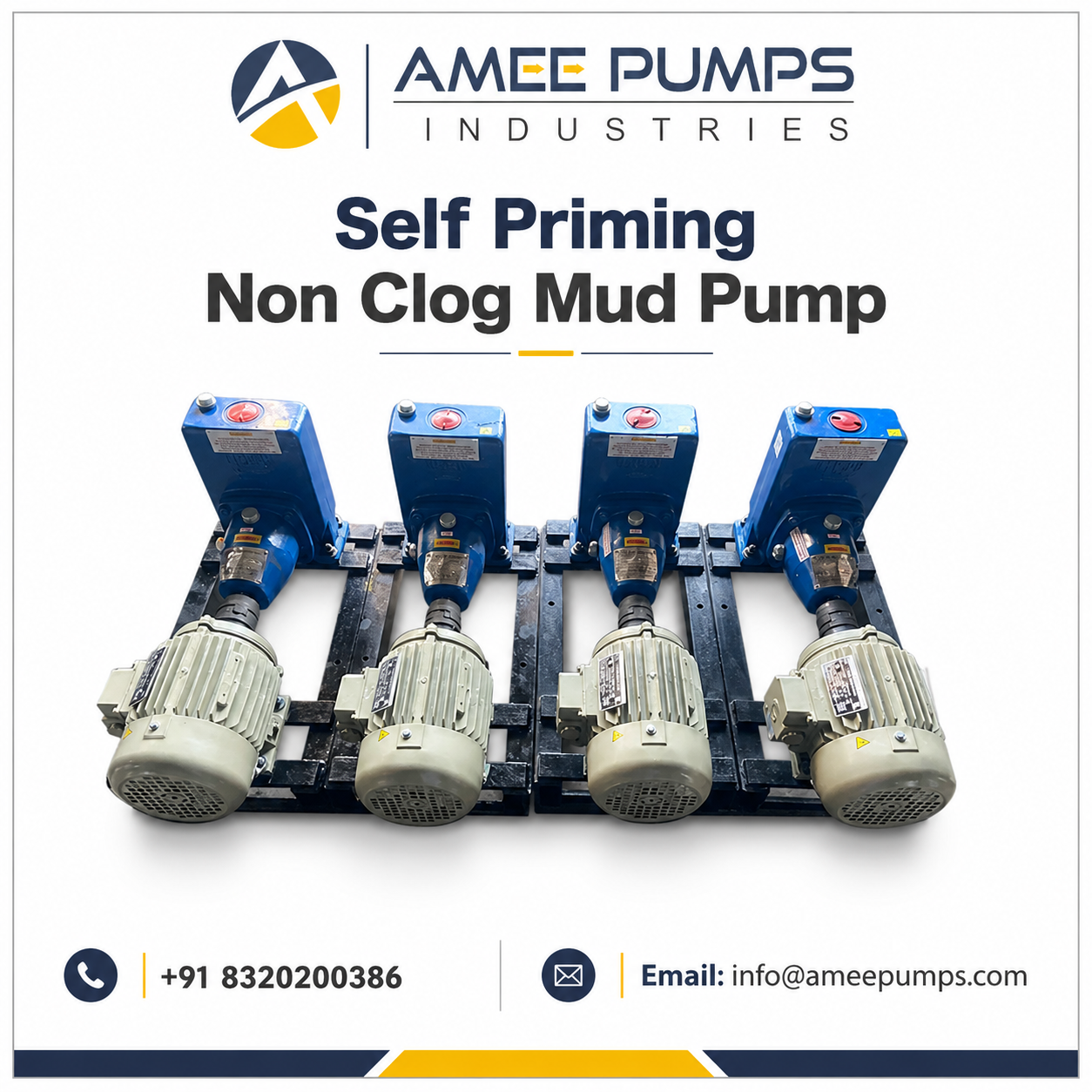
Self Priming Non Clog Mud Pump
Reliable Self Priming Non Clog Mud Pumps for industrial use in Ahmedabad. Expertly designed for efficient solids handling. Contact Amee Pumps Industries.
What is a Self Priming Non Clog Mud Pump? — Overview
A Self Priming Non Clog Mud Pump is a specialized centrifugal pump designed to handle fluids containing a high concentration of solids, such as mud, sludge, sand, and wastewater with debris. The "self-priming" feature means the pump can evacuate air from its suction line and casing, allowing it to lift fluid from a lower level without needing to be manually primed each time it starts. The "non-clog" design incorporates a large impeller passage and often a vortex or semi-vortex impeller type, which minimizes the risk of solids and stringy material obstructing the flow. These pumps are engineered for durability, using robust materials to withstand the abrasive nature of the fluids they handle.
Key Features and Technical Specifications
- Large Solids Handling Capacity: Designed to pass solids up to a specified diameter without clogging.
- Self-Priming Capability: Eliminates the need for manual priming, simplifying operation and reducing startup time.
- Robust Construction: Typically built with wear-resistant materials like cast iron, ductile iron, or specialized alloys for enhanced durability.
- Vortex or Semi-Vortex Impeller: Facilitates the passage of solids and stringy material, reducing the risk of blockages.
- High Efficiency: Engineered to move large volumes of fluid with minimal energy consumption.
- Durable Sealing: Features robust mechanical seals or gland packing suitable for abrasive and corrosive applications.
- Various Drive Options: Available with electric motors, diesel engines, or as bare shafts for custom configurations.
- Compact Design: Often designed for ease of installation and portability, especially for mobile applications.
Industrial Applications and Use Cases
- Construction Dewatering: Pumping water, mud, and debris from excavation sites, trenches, and building foundations.
- Wastewater Treatment: Transferring sludge, settled solids, and raw sewage in municipal and industrial treatment facilities.
- Mining and Quarrying: Moving slurries, tailings, and process water containing abrasive solids.
- Industrial Effluent Transfer: Pumping viscous waste streams from manufacturing plants, including chemical and food processing industries.
- Sand and Gravel Washing: Handling slurries in aggregate processing and washing plants.
- Tunneling Operations: Removing water and muck from underground construction projects.
- Agricultural Drainage: Clearing flooded fields and managing irrigation runoff containing organic matter.
- Marine and Dredging: Assisting in dredging operations and bilge pumping in marine environments.
How to Choose the Right Self Priming Non Clog Mud Pump
Selecting the appropriate pump is crucial for optimal performance and longevity. Consider these factors:
- Fluid Characteristics: Accurately identify the type of fluid, its solids content, particle size, abrasiveness, and viscosity. This is the most critical factor.
- Required Flow Rate and Head: Determine the volume of fluid to be moved per unit time and the total vertical and friction head the pump must overcome.
- Solids Handling Size: Ensure the pump's maximum solids passage capability exceeds the largest expected particle size.
- Material Compatibility: Select pump materials that can withstand the corrosive or abrasive nature of the fluid.
- Priming Requirements: Confirm the pump's self-priming lift capability meets the site's needs.
- Power Source: Choose between electric, diesel, or other drive options based on site availability and preference.
- Certifications and Standards: Verify compliance with relevant industry standards for safety and performance.
- Supplier Reputation and Support: Opt for a reputable manufacturer with a proven track record and reliable after-sales service.
Quality Standards and Compliance
When procuring a Self Priming Non Clog Mud Pump, verifying adherence to quality standards is non-negotiable. Reputable manufacturers will ensure their pumps meet or exceed relevant Indian Standards (IS) and international benchmarks like ISO certifications for quality management systems. For specific applications, compliance with standards related to electrical safety (like IEC) or material specifications might be necessary. Buyers should inquire about the manufacturing processes, material testing, and performance validation conducted by the supplier. A commitment to quality is often reflected in the warranty offered and the availability of spare parts and technical support.
Why Amee Pumps Industries' Experience and Capability Matters
At Amee Pumps Industries, our two decades of dedicated experience, led by Mr. Amit Panchal, have been instrumental in developing a deep understanding of the challenges faced by industries in Ahmedabad and beyond. We leverage a technology-driven approach to design and manufacturing, which allows us to create highly efficient and cost-effective Self Priming Non Clog Mud Pumps. Our manufacturing processes are honed for precision, ensuring each pump delivers reliable performance even in the most demanding applications.
We pride ourselves on our capability to not only produce standard models but also to offer customized solutions tailored to specific client requirements. Our quality control is rigorous, from material selection to final testing, ensuring that every pump leaving our facility meets stringent performance benchmarks. This focus on engineering excellence, combined with a commitment to customer satisfaction and timely delivery, makes Amee Pumps Industries a trusted partner for your critical fluid transfer needs.
Installation, Maintenance, and Care Tips
Proper installation and regular maintenance are key to maximizing the lifespan and performance of your Self Priming Non Clog Mud Pump.
- Installation: Ensure the pump is installed on a stable, level base to prevent vibration. Connect suction and discharge lines securely, minimizing bends and ensuring proper sizing to reduce friction losses. For self-priming models, verify that the suction line is airtight and submerged sufficiently.
- Initial Priming: Even self-priming pumps may require initial priming. Fill the pump casing and suction line with fluid before the first start-up.
- Regular Inspections: Periodically check for leaks around seals and connections. Inspect the impeller for wear or damage, especially if handling highly abrasive fluids.
- Lubrication: Follow the manufacturer's recommendations for lubricating bearings and other moving parts.
- Impeller Clearance: If wear is observed, the impeller clearance may need adjustment to maintain efficiency.
- Strainers: If the fluid contains large debris, consider installing a coarse strainer on the suction line, but ensure it doesn't restrict flow or become a clogging hazard itself.
- Seasonal Storage: If the pump will be idle for extended periods, especially in freezing conditions, drain it completely to prevent damage.
Frequently Asked Questions
A self-priming pump eliminates the need for manual priming before each use, which is a significant advantage when dealing with mud and solids. It can automatically draw fluid from a lower level after initial setup, simplifying operation and reducing labor.
Non-clog designs typically feature a larger impeller passage and often use vortex or semi-vortex impellers. These designs create a swirling action that helps move solids through the pump without getting lodged, allowing for the passage of larger particles and stringy materials commonly found in mud.
These pumps are designed to handle a variety of solids including mud, sludge, sand, gravel, small stones, and wastewater containing debris. The specific size and type of solids depend on the pump's design, particularly its solids handling capacity.
Inspection frequency depends heavily on the abrasiveness of the fluid being pumped and the duration of operation. For highly abrasive slurries, inspections might be needed weekly or monthly. For less demanding applications, quarterly checks may suffice.
While primarily designed for mud and solids, some models can handle certain chemicals if constructed with appropriate corrosion-resistant materials. However, for aggressive chemicals, specialized chemical process pumps are usually recommended. Always verify material compatibility.
The lifespan varies greatly based on application severity, maintenance practices, and pump construction. With proper selection, installation, and regular maintenance, a well-built mud pump can last many years, often exceeding 10-15 years in moderate service.
Conclusion
For industrial operations in Ahmedabad facing the persistent challenge of moving mud, sludge, and solids-laden fluids, a Self Priming Non Clog Mud Pump is an indispensable piece of equipment. The ability to self-prime, coupled with a robust non-clog design, ensures operational reliability and minimizes costly downtime. When selecting a pump, careful consideration of fluid characteristics, required performance, and material compatibility is essential. Partnering with an experienced manufacturer like Amee Pumps Industries, with a proven track record in precision engineering and customized solutions, guarantees you receive a durable, efficient, and cost-effective pumping system tailored to your specific needs.
Get In Touch
Amee Pumps Industries
